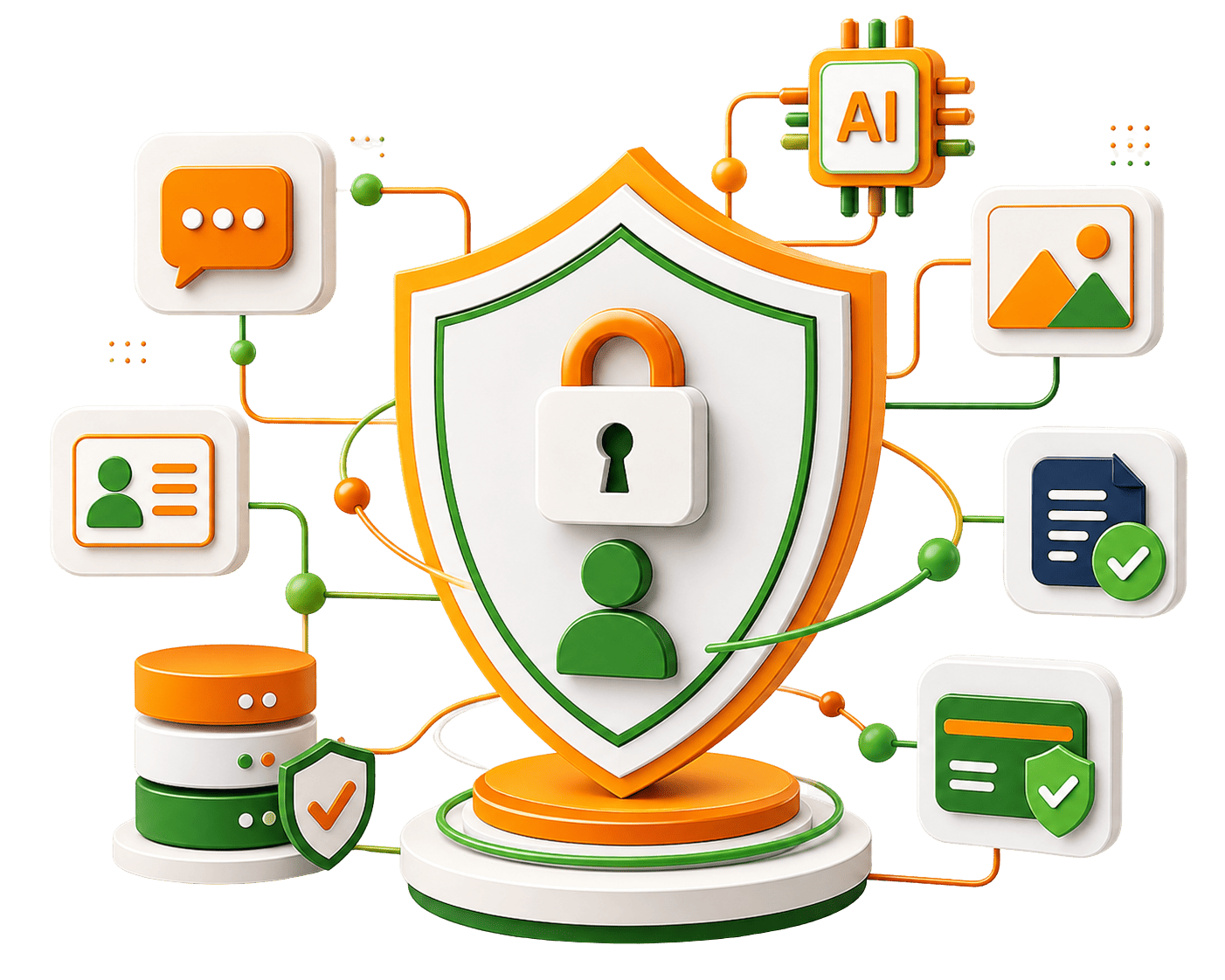
AI Security for Consumers: How to Protect Your Personal Data
Artificial Intelligence (AI) is changing how we search for information, communicate, shop, learn and access digital services. From AI chatbots and virtual assistants to image generators and personalised applications, these tools can make everyday tasks easier. However, using them safely requires awareness of how your personal information can be exposed, misused or manipulated.
As a consumer and a Data Principal under India’s Digital Personal Data Protection Act, 2023 (DPDP Act), you should know how to protect your identity, conversations, photographs, financial information and other personal data when interacting with AI-powered services.
This guide explains common AI security risks, practical steps to reduce them, and how to take action if something goes wrong.
01
RISKS
Understand the AI security risks you may face.
AI-related risks are not limited to hackers or technical attacks. They can affect anyone who uses digital services, social media, messaging platforms or AI applications.
AI Chatbots and Personal Data Exposure
AI chatbots may process the information you enter, upload or share during a conversation. Depending on the service and its settings, this information may be stored or used for additional purposes.
Protect yourself:
Never share passwords, PINs, OTPs, banking credentials or private encryption keys with an AI chatbot.
Avoid uploading identity documents, bank statements, medical records or confidential work documents unless necessary and appropriate safeguards are in place.
Remove names, phone numbers, account numbers and other identifying details before asking an AI tool to analyse a document.
Review the service’s privacy policy and data controls before sharing personal information.
AI Voice Cloning and Deepfake Scams
Criminals can use AI-generated voices, images and videos to impersonate family members, colleagues, public figures or customer support representatives. A familiar voice or convincing video is not proof that a request is genuine.
Protect yourself:
Verify urgent requests for money or sensitive information through a separate, trusted communication channel.
Establish a family verification phrase for emergencies, where appropriate.
Do not share OTPs, passwords or financial details simply because a caller sounds familiar.
Be cautious of unexpected video calls, investment offers and requests to install remote-access applications.
AI-Powered Phishing and Fraud
AI can help scammers create convincing messages, emails, websites and advertisements tailored to their targets. These messages may use correct grammar, familiar branding or personal details to appear legitimate.
Protect yourself:
Check the complete website address before signing in or making payments.
Do not open unexpected attachments or follow suspicious links.
Access banking, government and other important services through their official applications or websites.
Treat requests for urgent payments, account verification or confidential information with caution.
Unauthorised Use of Your Photos, Voice or Videos
Images, recordings and videos shared online can potentially be copied, manipulated or used to create misleading content or impersonations.
Protect yourself:
Think carefully before uploading personal photographs, voice recordings or videos to unfamiliar AI tools.
Review the permissions granted to photo-editing, face-swapping and voice-generation applications.
Avoid publishing identity documents, home addresses, travel details or other sensitive personal information publicly.
Report impersonation, non-consensual manipulated content or misuse of your identity to the relevant platform.
Excessive Access to Your Device
Some AI-powered applications request access to your microphone, camera, contacts, location, photographs or files. Unnecessary permissions can increase your exposure if an application or account is compromised.
Protect yourself:
Grant only the permissions required for the feature you want to use.
Review application permissions periodically.
Remove access that is no longer needed.
Install applications from trusted sources and keep your operating system and security software updated.
02
CHECKLIST
Before you use an AI tool: follow this safety checklist.
Use this checklist before sharing information with an AI chatbot, image generator, virtual assistant or other AI-powered service.
1
Check the provider: Confirm that the application or website is legitimate.
2
Read the privacy notice: Understand what information is collected and why.
3
Minimise personal information: Share only what is necessary for your task.
4
Review data settings: Look for controls governing chat history, retention, personalisation and model improvement.
5
Check permissions: Restrict access to your camera, microphone, location, contacts and files where possible.
6
Secure your account: Use a unique password and multifactor authentication where available.
7
Verify important outputs: Independently check AI-generated information before acting on it.
8
Know how to seek help: Identify the provider’s support, privacy and grievance channels.
Remember: A privacy setting or temporary chat feature does not necessarily guarantee that all information is immediately deleted or never retained. Check the provider’s actual terms and available controls.
03
WHAT TO AVOID
What personal information should you avoid sharing with AI?
Not every AI interaction requires your identity. Whenever possible, use generalised or anonymised information instead of identifiable personal details.
Information
Safer approach
Passwords, PINs and OTPs
Never share them with AI tools or people claiming to be support agents.
Aadhaar, PAN or passport details
Do not upload unless there is a genuine need and you have verified the service and its safeguards.
Bank account and payment details
Remove account numbers and other financial identifiers before analysis.
Medical records
Remove identifying details and use trusted services with appropriate privacy protections.
Personal photographs and voice recordings
Consider how they could be stored, reused, copied or manipulated.
Private messages and work documents
Remove names and confidential information before requesting a summary or analysis.
Children's personal information
Avoid sharing identifiable photographs, school details, locations or other unnecessary information.
04
YOUR RIGHTS
How can you protect your rights as a Data Principal?
India’s DPDP Act establishes rights and obligations relating to the processing of digital personal data within its scope. These rights can be relevant when organisations process personal data through AI-powered services.
Understand Why Your Data Is Being Processed
Where required under the Act, a Data Fiduciary must provide a notice explaining the personal data being processed and the purpose of processing.
Your action: Read the privacy notice and look for explanations of how your information is used by the service, including its AI-related features.
Make Informed Consent Decisions
Where consent is the basis for processing, it must meet the requirements of the DPDP Act.
Your action: Review consent requests carefully. Where applicable, you can withdraw consent through the available process.
Request Access to Information
The Act provides rights to obtain information about personal data and its processing, subject to the applicable provisions.
Your action: Contact the relevant Data Fiduciary to understand what information about you is being processed and how to exercise your rights.
Seek Correction or Erasure
The Act provides rights relating to correction, completion, updating and erasure of personal data, subject to its provisions and applicable retention requirements.
Your action: If your personal information is inaccurate or you want it erased, where applicable, submit a request through the organisation’s designated channel.
Raise a Grievance
Data Principals have a right to grievance redressal under the Act, subject to its provisions and applicable procedures.
Your action: If your privacy concern remains unresolved, follow the organisation’s grievance process and the applicable escalation procedure.
Important: These rights do not mean that every AI-generated output, model parameter or AI model can be accessed, corrected or deleted on demand. The applicable rights depend on the personal data involved, the circumstances and the law.
05
IF SOMETHING GOES WRONG
What should you do if your personal data is exposed or misused?
If you believe an AI application, online scam or impersonation has compromised your personal information, act promptly.
1
Secure your accounts. Change compromised passwords, sign out of active sessions where possible and enable multifactor authentication.
2
Stop further sharing. Revoke unnecessary application permissions, disconnect suspicious integrations and stop communicating with suspected scammers.
3
Preserve evidence. Save relevant messages, screenshots, website addresses, transaction references and complaint acknowledgements. Avoid sharing additional sensitive information while reporting the incident.
4
Contact the relevant service provider. Report the incident through its official security, privacy or grievance channel. Request appropriate action regarding your personal data or the fraudulent content.
5
Protect your finances. If financial credentials or payment details are compromised, contact your bank or payment provider immediately and follow its instructions.
6
Report cybercrime in India. For suspected cybercrime, use the official National Cyber Crime Reporting Portal at https://cybercrime.gov.in. For financial cyber fraud, call India’s cybercrime helpline at 1930 as soon as possible.
7
Exercise your applicable data protection rights. Where relevant, submit a request or grievance to the organisation processing your personal data and follow the applicable escalation process.
06
FAMILY
Teach your family to use AI safely.
AI security is also a family and community concern. Children, older adults and people unfamiliar with emerging technologies may be targeted through convincing messages, impersonation and misleading AI-generated content.
Help your family build these habits:
Verify a person's identity before sending money or sharing confidential information.
Never share OTPs, passwords or banking credentials in response to unexpected requests.
Ask for help before installing unfamiliar applications or granting access to personal information.
Check the source of AI-generated news, images and videos before forwarding them.
Review children's privacy settings and discuss what they should avoid sharing online.
Report suspicious activity instead of engaging with potential scammers.
07
YOUR ROLE
Your AI security responsibilities and data protection rights.
Safer AI use requires both individual awareness and responsible data handling by organisations.
As a consumer, you can reduce your exposure by limiting the information you share, securing your accounts, checking permissions and verifying suspicious requests. Organisations processing your personal data must meet the applicable obligations under the DPDP Act, including requirements relating to consent where applicable and reasonable security safeguards.
The DPDP Act does not address every AI-related threat, such as all forms of deepfake fraud or misinformation. Other laws, platform policies and cybersecurity measures may also be relevant.
Make AI Work for You Without Compromising Your Privacy
AI can be a useful part of everyday life when you understand its limitations and make informed choices about your personal information.
Before using an AI service, pause and ask: Do I need to share this information? Do I trust this service? Do I understand how my data may be used?
A few simple precautions can help you reduce unnecessary exposure, recognise suspicious activity and make better use of your rights as a Data Principal.
Stay alert. Protect your identity. Use AI thoughtfully.